KABUL, Afghanistan, December 27, 2025 (ENS) – Food insecurity threatening lives and livelihoods is on the rise in Afghanistan as winter closes in. More than 17 million Afghans are facing starvation in freezing temperatures as the scale and severity of hunger and malnutrition deepens, warns the United Nations World Food Programme, the world’s largest humanitarian organization.
Known as the WFP, the UN agency saves lives in emergencies and uses food assistance to build paths to peace, stability and prosperity for people recovering from conflict, disasters, and the impact of the warming climate that does not spare people who live in vulnerable locations, even snowy, icy ones.
But this year, the agency’s resources are falling behind the growing need for food in the 120 countries it serves.

A 12th grade graduate, she is unemployed. She dreams of continuing her studies, but schools and universities for girls remain closed. (Photo © WFP/Isheeta Sumra)
New food security figures from the latest Integrated Food Security Phase Classification, IPC, report for Afghanistan indicate that three million more women, men, and children face acute hunger or worse (IPC3+) compared to the 14.8 million last year.
Child malnutrition, too, is projected to rise, affecting nearly four million children in the coming year. With child malnutrition already at its highest level in decades, and unprecedented reductions in funding for agencies providing essential services, access to treatment is increasingly scarce.
Left untreated, malnutrition in children is life-threatening with child deaths likely to rise during the harsh winter months when food is scarcest. All key indicators point to a brutal winter season ahead for Afghanistan’s most vulnerable families.
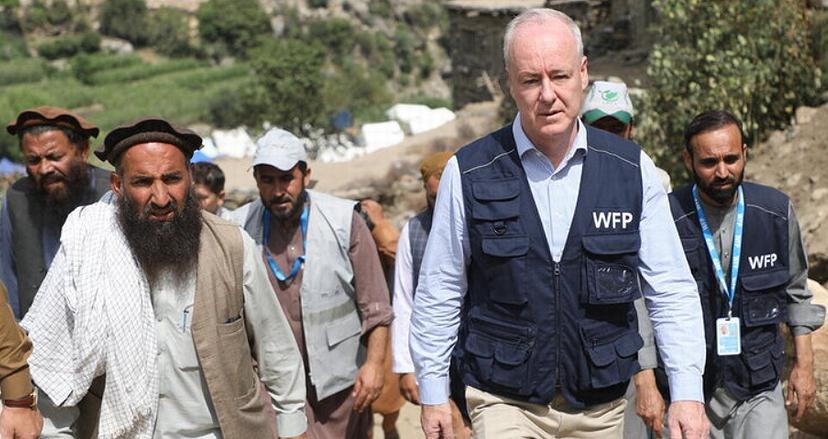
“WFP has been warning for months about the clear signs of a deepening humanitarian crisis in Afghanistan, and the latest data confirms our worst fears,” John Aylieff, WFP Country Director in Afghanistan, said. “Our teams are seeing families skipping meals for days on end and taking extreme measures to survive. Child deaths are rising, and they risk becoming worse in the months ahead.”
Afghanistan is dreading a harsh winter as multiple crises converge. Drought has affected half the country and destroyed crops. Job losses and a weakened economy have eroded incomes and livelihoods. A devastating earthquake this summer has left families homeless, pushing humanitarian needs to new extremes.
Forced returns from Pakistan and Iran are further compounding needs, with 2.5 million Afghans sent back to Afghanistan since the beginning of the year, many arriving malnourished and destitute. Nearly as many more are expected to return in 2026.
While the crisis deepens, humanitarian aid for Afghanistan is shrinking, leaving millions without the support that has historically curbed severe hunger and malnutrition.
“We need to bring Afghanistan’s crisis back into the headlines to give the most vulnerable Afghans the attention they deserve,” Aylieff urged. “We must stand with the people of Afghanistan who depend on critical support to survive, and deploy proven solutions towards a recovery with hope, dignity and prosperity.”
For the first time in decades, the World Food Programme does not have the resources to launch a robust winter response, while also scaling up emergency and nutrition support nationwide.
Donations to the World Food Programme are voluntary. Now the WFP urgently requires US$468 million to deliver life-saving food assistance to six million of Afghanistan’s most vulnerable people to help them survive the harsh winter.
With immediate funding, WFP is ready to mount a large-scale winter response – ensuring families can push back hunger and escape falling deeper into crisis.
“We talk to traditional donors who are doing all they can,” said Aylieff. “They’re stretching but they can only go so far. We’re appealing to anyone – high-net-worth individuals, foundations, donors that may not have thought of supporting Afghanistan in the past. This is the Afghan people’s hour of greatest need. Donors have worked with WFP to save countless lives for decades, especially during periods like winter when hunger peaks. Now there’s so little to go around.”
Global Food Insecurity Growing
“The scale of the current global hunger and malnutrition crisis is enormous,” the World Food Programme says, warning of a food crisis in 68 countries. “A staggering 318 million people face crisis levels of hunger or worse next year – more than double the figure recorded in 2019 – according to WFP’s 2026 Global Outlook.
Two simultaneous famines have been confirmed in parts of Gaza and Sudan, a first this century. And many food crises involve multiple overlapping issues that are building year on year, the WFP explains.
The UN agency gives the four main causes of the global food crisis as conflict, climate, economy and displacement.
Nearly 70 percent of acutely food-insecure people lived in fragile or conflict-affected countries in 2025. Violence and instability in the Middle East, East, Central and West Africa as well as in the Caribbean, southern Asia and Eastern Europe are particularly concerning to the WFP, the agency says. “Conflict disrupts food production, forces people from their homes and sources of income, and often hinders humanitarian access to people in most need.”
“The climate crisis is one of the leading causes of the steep rise in global hunger. Climate shocks destroy lives, crops and livelihoods, and undermine people’s ability to feed themselves. Hunger will spiral out of control if the world fails to take immediate climate action,” the WFP emphasizes.
As far as the global economy is concerned, the WFP says sluggish global growth and economic stressors, linked to slow pandemic recovery and fallout from the war in Ukraine, continue to affect low and middle-income countries. “This limits investment in social protection programs, at a time when food prices remain at crisis levels,” are among the interconnected causes of food scarcity.
Finally, forcibly displaced people are vulnerable to food insecurity, which is multiplied by limited access to employment, food and shelter, and reliance on dwindling humanitarian assistance.
“A coordinated effort across governments, financial institutions, the private sector and partners is the only way to end the global food crisis,” the WFP explains, giving the example of as the east African country of Somalia, where the international community came together and managed to pull people back from the brink of famine in 2022.
Political and diplomatic solutions are needed to strengthen peacebuilding efforts and ensure safe and unrestricted access across borders and conflict lines to save lives and prevent the hunger catastrophe from spreading even further.

WFP Builds Resilience Across the World
But it is not enough to keep people alive. The WFP believes, “We must go further, and this can only be achieved by addressing the underlying causes of hunger.”
WFP’s work to build resilience, adapt to climate change, promote good nutrition and improve food systems lays the foundations of a more prosperous future for millions.
One example of this resilience fortification is that in just four years, WFP and local communities turned 158,000 hectares (390,426 acres) of barren fields in the Sahel region of five African countries into farm and grazing land.
The WFP climate insurance program – the R4 Rural Resilience initiative – had benefited nearly 550,000 vulnerable households and families in 18 countries across Africa, Asia, and Latin America and the Caribbean by 2023.
At the same time, WFP is working with governments in 83 countries to boost or build national safety nets and nutrition-sensitive social protection, allowing the UN agency to reach more people with emergency food assistance.
But the WFP warns that severe funding shortfalls are forcing the agency to scale back assistance and refocus efforts on the most severe needs.
“With persistent access constraints also hampering support, some of the most vulnerable people are being left behind,” the WFP warns. “Unless resources are made available and unrestricted access granted, lost lives and the reversal of hard-earned development gains will be the price to pay.”
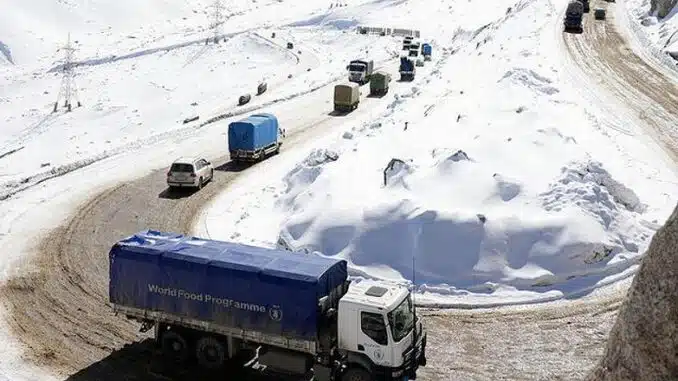
Featured image: One of a fleet of World Food Programme trucks on the road to the Salang Pass – a vital route connecting Afghanistan’s capital city of Kabul with northern and southern regions of Afghanistan. December 27, 2025 (Photo courtesy WFP/Philippe Kropf)
© 2025, Environment News Service. All rights reserved. Content may be quoted only with proper attribution and a direct link to the original article. Full reproduction is prohibited.