By Li Sujun
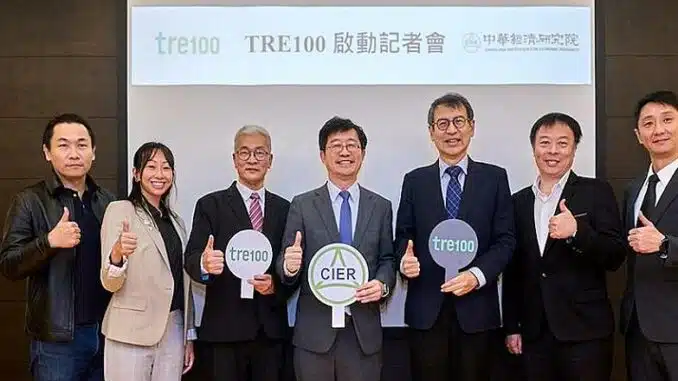
TAIPEI, Taiwan, December 20, 2025 (ENS) – The Chung-Hua Institution for Economic Research launched the “TRE100” green energy initiative on December 12, showing that its standards and certification mechanisms are consistent with the international RE100 green energy drive.
RE100 gathers the world’s most influential businesses committed to using 100 percent renewable electricity in their operations. Led by Climate Group in partnership with CDP, the RE100 mission is to accelerate change towards zero carbon grids at scale.

The TRE100 Initiative, also called Taiwan Renewable Energy 100, is a platform launched by the Center for Energy and Environmental Research, CIER, in Taiwan to help enterprises implement renewable energy strategies and transition toward sustainability, aligning with international net-zero communities.
But there are no electricity consumption threshold restrictions for members, making it a green energy initiative designed for Taiwanese small and medium-sized enterprises, SMEs. Through TRE100, they can better communicate with the international supply chain.
The first batch of participating companies stated that many of Taiwan’s “hidden champions” control the most critical elements of the international supply chain and are also required to achieve carbon reduction and green energy targets.
Most of their green energy is purchased by TSMC, the Taiwan Semiconductor Manufacturing Company Ltd. This multinational semiconductor contract manufacturing and design company is the world’s largest dedicated independent semiconductor foundry, and Taiwan’s largest company. Its headquarters and main operations are located in the Science Park in Hsinchu, Taiwan.

Small and medium-sized enterprises can also join the RE100 framework without the 100 million-degree threshold.
The Chung-Hua Institution for Economic Research launched the TRE100 Green Energy Initiative, establishing a Taiwanese version of the green energy commitment framework.
CIER explained that TRE100 is a sub-initiative of the international RE100 initiative, and its standards are aligned with RE100 technical specifications, including green energy source identification, usage calculation methods, and annual disclosure, ensuring consistency among companies and avoiding discrepancies in international review.
The only difference is that TRE100 has no electricity consumption threshold, allowing domestic SMEs and smaller electricity consumers to join the platform.
CIER President Lien Hsien-ming explained that because RE100 requires participating companies to have an annual electricity consumption of 100 million kilowatt-hours, many companies have not met this requirement.
Still, many small and medium-sized enterprises in Taiwan are “hidden champions” and are also subject to carbon reduction or green energy requirements from the international supply chain.
Through RE100, more Taiwanese companies can join, enhance their overall green competitiveness, and contribute to the energy transition.
In addition to connecting with RE100, TRE100 also provides a platform for SMEs to discuss and gather green electricity demand, Hsieh Han-chang, deputy director-general of the Bureau of Standards, Metrology and Inspection, Ministry of Economic Affairs, said in an interview.

After clarifying the green electricity demand of SMEs, the supply side can better participate in the complete supply and demand market.
The relevant verification system is also consistent with the existing green electricity verification system, so there is no need to establish a new model.
Small and medium-sized enterprises are facing difficulties, while hidden champions are crying out for green electricity.
The initial group of enterprises joining TRE100 includes Gudeng Precision Industrial Co., Ltd., FSP Technology Inc., and SUSS MicroTec SE, all of which are key manufacturers with substantial international supply chain integration, as well as Hughes Microelectronics.
These companies have long faced green energy audits from the technology industry and multinational brands.
Gudeng’s Sustainability Chief Executive Yu Li-chih said in an interview that the company consumed approximately 17 million kilowatt-hours of electricity last year and announced its goal of achieving 100 percent renewable energy use by 2040.
“But saying it ourselves is useless,” Yu said, adding that participating in the TRE100 platform certification is equivalent to participating in an international initiative, which helps in communication with foreign companies.
Yu explained that many micro-enterprises in Taiwan control the most critical components of the international supply chain, perhaps as small as a single screw. However, currently, domestic SMEs still struggle to obtain green electricity, with “most being bought by TSMC.”
FSP spokesperson Yao Wen-chun pointed out that basic components are simply “bought and sold” among various companies. When asked to keep up with mainstream initiatives, these SMEs may not be able to participate in RE100.
TRE100 can provide a clear set of guidelines, allowing for participation and mutual assistance. It is expected that the future procurement market can encompass more diverse considerations, promoting the reshaping of the value chain.
In the new normal of international climate governance, businesses are focusing on carbon emissions in their supply chains.
Alisha Lee, RE100’s representative in Taiwan, explained that the RE100 initiative, launched in 2014, now has over 400 members, most of whom have already achieved their reduction targets for direct emissions (Category 1) and indirect energy emissions (Category 2).
For example, Apple aims to achieve net-zero emissions by 2030, but statistics show that nearly 40 percent of its emissions come from its supply chain.
Therefore, the international community is now focusing on other indirect emissions (Category 3), requiring the supply chain to use renewable electricity, and welcomes RE100’s expansion to include companies of different sizes.
Lin Tzu-lun, deputy executive director of the Executive Yuan’s Energy and Carbon Reduction Office, pointed out that under the global net-zero trend, the demand for green electricity has spread from large enterprises to small and medium-sized enterprises, making renewable energy a standard requirement.
Although SMEs are not major electricity consumers, they also face pressure from the EU’s Carbon Border Adjustment Mechanism, CBAM, brand procurement regulations, and Environmental, Social, and Governance audits, used by investors and stakeholders to evaluate a company’s sustainable, ethical, and responsible practices beyond financial performance. They are required to propose concrete carbon reduction paths.
TRE100 provides a format that is easy to identify internationally, improves the transparency of supply chain negotiations, and allows SMEs to connect with international climate governance through this platform. At the same time, it can also expand the forces stabilizing demand and fill the gaps beyond large electricity consumers. ###
Editor’s Note: This report was initially published in Chinese by the Taiwan Environmental Information Center. Used with permission.
Featured image: The Chung-Hua Institution for Economic Research, CIER, held a press conference to launch the TRE100 initiative. December 12, 2025, Taipei City, Taiwan (Photo courtesy CIER)
© 2025, Environment News Service. All rights reserved. Content may be quoted only with proper attribution and a direct link to the original article. Full reproduction is prohibited.